
When those two lines appear on a pregnancy test, it can feel like a tiny moment of magic. But behind those lines is an extraordinarily complex process – and fertility isn’t just about reproductive health but our lifestyle choices and everyday habits.
Our fertility is influenced by far more than our reproductive system alone. The choices we make from the time we wake, to the food we put on our plate and how we respond to stress all play a key role in our overall wellbeing and cycle health.
And the good news is that it can take just a series of small fixes to make a big difference to our conception success.
We can build a strong foundation for fertility health and give ourselves the best outcomes by making sure the main eight pillars of health and wellbeing are supported; having good sleep and rest, reducing our exposure to toxins, being well nourished, prioritising our emotional health, relationships and connection with ourselves and others.
At Thrive Journey we know just how important it is for you to feel nourished and nurtured with trusted and empathetic fertility support and infertility support.
Fertility Wellness Starts With Understanding Your Cycle
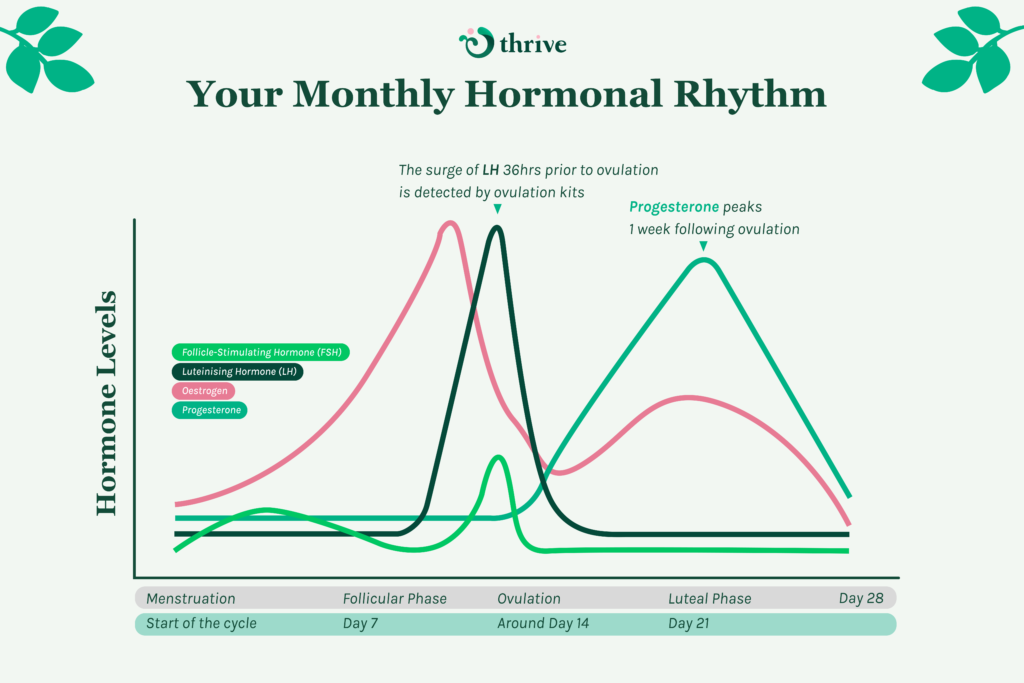
Having knowledge of your biological rhythm and how this relates to your energy levels, mood and fertility is key to understanding yourself and your cycle.
There are four main phases of the menstrual cycle. Menstruation typically lasts around 3–7 days, and during this time you may notice lower energy levels. Although we often talk about menstruation as a separate phase, technically the follicular phase begins on day one of your period and continues once bleeding has finished. This is when the ovaries grow and mature eggs and as oestrogen levels rise this also brings a rise in energy, mood and focus.
This phase transitions to Ovulation when the egg is release and is the peak fertility window. This is when women typically feel more confident, energetic and social. The cycle moves to the Luteal Phase (day 14 to 28)- when progesterone levels sharply increase and decrease, which can make you feel tired, perhaps emotionally vulnerable and detrimentally affect your sleep quality. Week 4 – the progesterone decreases and we get the possibility of PMS and lots of anger and heightened emotional volatility.
Understanding where you are at in your cycle can give you a stronger connection to your mind and body when you are trying to conceive. You appreciate the role of hormones and you can adapt your routine, for example, doing more restful activities during the Luteal Phase.
Natural Fertility Support Through Everyday Lifestyle Habits
Approximately 1 in 6 people globally experience infertility at some point in their lives (1). Fertility is influenced by many different factors, but caring for your overall health and wellbeing can play an important role in supporting your chances of conception.
Thrive Journey yoga therapist, Sarah Manning says: ‘Making sure you lead a healthy lifestyle, which means eating the right foods, staying hydrated, with regular exercise, using stress management tools and good sleep habits, can positively affect pre-existing health conditions and a couple’s fertility wellness – whether assisted or natural.”
The Importance of Rest and Sleep
If you are feeling constantly on edge, this will mean cortisol levels can remain high and interfere with sleep and reduce your natural progesterone levels – which are important for healthy conception.
Set aside time in the evening to wind down from the day. Create a calming evening routine – you may like to do a restorative Yoga class, take a bath, journal or read a book before turning out the lights.
Build consistent sleep habits such as going to bed and waking up at the same time each day, keeping your bedroom dark and removing devices from your bedroom.
Mindfulness for fertility
Mindfulness and Deep relaxation practices are also helpful to ease stress levels and support hormonal balance.
And the stress of coping with infertility adds its own challenges and according to one study can exacerbate anxiety and emotional distress (2).
Regular micro mindfulness practices through the day, where you take a moment to breathe, notice your senses and observe thoughts can help to reduce anxiety, depression and stress.
Restorative and Yin Yoga is also helpful for providing emotional support for infertility, creating space to rest and navigate the uncertainty and challenges accompanying this journey and aiding fertility self-care.

1. Nourishment for Hormonal Balance
Nutrition is one of the building blocks for fertility. Focus on eating plentiful healthy foods rather than a restrictive “fertility” diet. Eat regular, balanced meals and avoid having dinner less than four hours before you go to bed.
Always opt for wholefoods over processed or fast foods and eat the rainbow – brightly coloured fruits and vegetables, such as carrots, berries and greens. Eat healthy fats such as olive oil, avocado, nuts, seeds and oily fish which all support hormone function.
Other fertility nutrients include folate, iron, iodine, zinc, Vitamin D and omega-3 fatty acids. Check out our Thrive Journey guide to nutrition for fertility.
2. Movement That Supports Rather Than Depletes
It’s always a good idea to reflect on your energy and tune into your body’s needs rather than pushing through. So choose activities which increase your energy rather than deplete you.
A walk in nature or a gentle yoga routine is likely to be much better for you than a circuit session or a hard run on days when you feel drained. Yoga for fertility can be especially beneficial. A study (3) published in the International Journal of Yoga has shown that yoga supports stress reduction, emotional wellbeing and nervous system regulation through its integrated mind-body approach.
So, listen to your body’s needs and practise self-compassion. Ride your energy waves instead of feeling locked into a punishing gym schedule.

Conclusion
Fertility wellness is about softening rather than pushing, valuing stillness over achievement and practicing self-care and self-compassion.
Be kind to yourself and let go of aiming to be perfect, instead embrace small, consistent habits that you can weave into your life.
These actions help to support our hormonal balance and cycle health. At Thrive we offer fertility support which includes holistic health and overall wellbeing so you feel at your best physically and mentally through this and every stage of your journey.
FAQS
We chatted to our Thrive Journey Yoga Therapist and expert, Sarah Manning to ask the following questions:
Q: What lifestyle factors support hormonal balance?
A: Our hormones don’t work in isolation. Stress, sleep, nutrition, movement and other lifestyle factors can all influence the systems involved in hormonal and reproductive health. Supporting your overall wellbeing can therefore be an important part of fertility wellness.
Some areas to consider include:
Regular movement – supports circulation, overall health and wellbeing.
Time in nature – can be a simple way to unwind and manage stress.
Finding balance – creating space for rest, creativity and simply being, rather than always doing.
Quality sleep – prioritise a regular sleep routine and reduce bright screens and stimulating activities before bed.
Hydration – staying well hydrated supports normal body function.
Stress management – yoga, breathing practices, meditation and relaxation can all help.
Healthy relationships and boundaries – addressing ongoing stress at work or within relationships can support emotional wellbeing.
Balanced nutrition – include plenty of whole foods, fibre, protein and healthy fats, while limiting excessive refined sugars and highly processed carbohydrates.
Micronutrients – vitamins and minerals are important for overall and reproductive health. If considering supplements or herbal remedies, seek individual advice from an appropriately qualified healthcare professional.
Q: How can Ayurveda support fertility wellbeing?
A: Ayurveda, meaning “the science of life”, is a traditional Indian system of wellbeing that takes a whole-person approach to health. Rather than looking at fertility in isolation, an Ayurvedic assessment covers holistic fertility support and may consider sleep, digestion, energy levels, skin, hair tongue, pulses at the wrist and other physical signs, alongside emotional wellbeing and lifestyle.
Recommendations are then tailored to the individual and may include changes to diet, daily routines, movement, rest and other lifestyle practices.
Ayurveda for fertility begins with supporting your overall health and creating greater balance within the body and mind. While Ayurveda cannot guarantee or directly improve fertility outcomes, its focus on nourishment, rest, stress management and healthy daily habits can complement your broader fertility wellbeing plan
How Thrive Supports Women’s Fertility Wellness
At Thrive we understand that fertility wellbeing is far more than reproductive health – it’s about supporting you physically, mentally, energetically and emotionally.
We blend the ancient wisdom of Ayurveda, Yoga and Qigong with breathwork and holistic health to offer holistic fertility journey support.
With a wide range of live classes including specialised Fertility Yoga and Nourishing Restorative Yoga and Yin Yoga, as well as a library of On Demand classes and relaxations including a fertility relaxation program with 30 guided relaxations, hormonal rebalance for IVF and hormonal rebalance for frozen embryo transfer (FET), so you can create a timetable that suits your schedule.
All this among a global community of like-minded women and health care professionals.
References:
1: World Health Organization fact sheet:
https://www.who.int/news-room/fact-sheets/detail/infertility
2: The relationship between stress and infertility.Rooney KL, Domar AD. Dialogues Clin Neurosci. 2018 Mar;20(1):41-47. doi: 10.31887/DCNS.2018.20.1/klrooney. PMID: 29946210; PMCID: PMC6016043.
https://pmc.ncbi.nlm.nih.gov/articles/PMC6016043
3: Reducing Stress with Yoga: A Systematic Review Based on Multimodal Biosignals. Int J Yoga. 2023 Sep-Dec;16(3):156-170. doi: 10.4103/ijoy.ijoy_218_23. Epub 2024 Feb 9. PMID: 38463652; P Khajuria A, Kumar A, Joshi D, Kumaran SS. MCID: PMC10919405.