
Disturbed sleep is one of the most common complaints facing women of all ages. But the reasons for sleeplessness can vary according to life stage. Here’s our Thrive Journey guide on how to find the best relaxation technique for you.
There’s nothing worse than going to bed exhausted – but not being able to fall asleep or nodding off only to wake up a few hours later with your head buzzing with ideas, or managing to sleep but waking up more tired than when you went to bed!
For many of us, sleep issues are frustratingly common.
In fact, women are 40 per cent more likely to have insomnia than men. (1)
It’s important to maintain healthy sleep hygiene, but to really reduce those sleeping issues you should target relaxation practices specific to your life stage because hormones, stress triggers, lifestyle factors and physical needs vary enormously.
Check out our sleep relaxation techniques for women of all ages and stages.
Why Women’s Sleep Needs Change Across Life Stages
Sleep is one of the main foundations of health – we all know how miserable and depleted we feel when we don’t get enough shut-eye.
Not only does it reduce our focus and put us in a bad mood, but the long-term consequences can increase your risk for health issues such as heart disease, high blood pressure, weight gain and a compromised immune system.
Sleep – especially deep sleep – is when our tissues repair, our bodies heal and even our brain is flushed of toxins.
Each of the Life Stages from teens, fertility, pregnancy, postpartum, perimenopause, menopause and beyond all have different sleep issues. This is due to hormonal changes, our mental and physical health, lifestyle, anxiety and stress.
In particular our hormones play a key role in sleep.
The main players are progesterone, oestrogen and cortisol.
Progesterone is a calming hormone which helps us to fall – and stay – asleep. This hormone is impacted by chronic stress and also disrupted during perimenopause when levels fluctuate and can reduce quite dramatically.
Oestrogen is a sleep regulator, so when levels oscillate, it can lead to night sweats and hot flushes – meaning our sleep is even more restless.
Then there’s cortisol – this hormone should naturally be higher in the morning and gradually reduce through the day, so levels are low by the time we go to bed. But chronic and prolonged stress can disrupt this pattern, leading to constantly high levels – and feeling ‘tired but wired.’
And ever wondered why tweens and teens stay up (and wake up) so late? It’s because their circadian rhythm is set a bit later than ours – meaning they don’t feel sleepy until later at night, which is a problem when they have to get up so early for school.
So, there is actually a biological reason why your teen is fighting that bedtime curfew.
This is why we need stage-aware relaxation techniques for women’s sleep that address why they’re not sleeping – instead of general tips.

Relaxation Techniques for Women’s Sleep: Stage by Stage
Teens: Navigating Changing Sleep Patterns
For teens
Not only are teens’ body-clocks “set” a little later, but there is pressure among peers for young people to stay up, so avoid making bedtime a battleground and instead, be understanding and aim to invite the right conditions to induce sleep.
Be a role model and ditch your device an hour before bed. It’s good to have everyone in the family put their phones away and switch to a more relaxed environment to unwind from the day. Avoid caffeine after lunchtime – especially energy drinks, which can make anxiety worse.
You could encourage simple breathwork and gentle yoga – which is especially helpful if your tween or teen has exams or social anxiety. The menstrual cycle also affects our sleep rhythms – during ovulation we typically have more energy and may find it harder to wind down, and in the luteal phase we usually need more rest.
Sleep is especially important at this age because it helps to regulate emotions and improves focus for study.
Tips for Teens
The 4-7-8 breath:
This simple breathing practice, developed by Dr Andrew Weil, is a good way to create a feeling of calm before bed. You can also do this practice anytime during the day to help reset your nervous system. Take a breath in for four counts, then hold for seven counts and then exhale forcefully through the mouth for eight counts. Repeat for 4 rounds, gradually increasing to 8 rounds.
Bedtime yoga for better sleep
Put your PJs on and do a few minutes of yoga to stretch away stress. Postures such as Child’s Pose, Cat-Cow and a Seated Forward Fold are all great ways to decompress from the day.
Young & Childless Adults: Quieting a Busy Mind
In our 20s we start to add more layers to our lives: study, career, relationships… as these layers accumulate, our lives become busy making it harder to switch off. This is when stress is usually the primary sleep disruptor. Stress, burnout and managing challenges at work can all affect our sleep.
Tips for this Life Stage
Progressive muscle relaxation (PMR)
This technique was pioneered by Dr Edmund Jacobson in the 1920s and is based on the theory that physical relaxation can lead to mental relaxation. Research on burns patients who tried this technique found that after just three days of practicing for 20-30 minutes per day that the practice decreased their anxiety and improved their sleep quality (2).
The idea is to work different parts of the body from the feet up to the head. Begin by curling the toes and feeling the tension in the feet, hold for five seconds and then release completely. Then continue to work through the rest of the body. Tensing and releasing the legs, abdomen, shoulders, arms and face. Then feel the whole body completely relaxed. This is a good practice to help create mind-body awareness and for anyone who feels it difficult to ‘switch off’.
Guided body scans and Yoga Nidra
Yoga Nidra means psychic sleep and is a relaxation practice which helps you to relax, promotes good quality sleep and can lower anxiety levels.
It is a set sequence of instructions and includes elements such as a “rotation of consciousness”, where you progressively relax different parts of the body, set an intention and explore guided visualisations.
Fertility & Preconception: Calming the Nervous System
Good quality sleep is especially important if you are trying for a baby. For this life stage it is about lowering stress levels and reducing cortisol (the body’s main stress hormone).
If cortisol levels are high, this can activate the HPA axis which leads to a reduction of progesterone which is needed to build the womb lining and regular ovulation.
Soothing breathing practices.
Diaphragmatic breathing
For this practice, sit upright or lie in Savasana. Place one hand on your lower belly and the other on your heart centre. Take a breath in through your nose, feeling your belly gently rise and your rib cage expand. When you are ready to release the breath, notice the chest and belly lower. Continue for 5-10 rounds, noticing the gentle rise and fall of the body with the breath. This practice encourages a long, slow breath which switches on the relaxation response, easing the body into the parasympathetic nervous system – the healing state also known as: rest, digest and nest.
Restorative Yoga
Lying with your legs up the wall, or in Child’s Pose are also helpful to invite the body into a relaxed state. Spend at least 5-10 minutes, undisturbed in your favourite restorative pose to help you de-stress and relax.
Pregnancy: Safe, Gentle Relaxation for Restful Nights
Pregnancy is massive change – both mentally and physically. Not only will you have a lot of thoughts racing around your mind, but physically you can have sleep disturbances from needing to pee through the night, (as your baby presses down on your bladder), to heartburn, anxiety and back pain.
In fact up to 80% of pregnant women report insomnia or significant sleep disturbances during pregnancy, particularly in the third trimester.
From 20 weeks, it is advised to do side-lying relaxation poses – using props such as bolsters and blankets to support your body. And it’s important to avoid any breath holds, instead focusing on pregnancy sleep relaxation techniques that involve long, slow exhalations.
The Golden Ribbon Breath
Sit or lie on your side, supported by props. Take a breath in through your nose and then very slightly part the lips and softly release the breath through your nose. Imagine your exhaled breath like a golden ribbon of light. Picture it in your mind as it unravels into the distance until it fades away. Repeat 5-10 times.
Postpartum: Quick Practices for Exhausted New Mothers
Soon after birth, comes the Baby Blues – affecting about 80 per cent of new mums and this is when all the pregnancy hormones come crashing down, leaving you feeling exhausted, low and anxious. For most women settles after about three days. But the sleepless nights can linger – for a long time!
Make sleep and rest a priority – and we’re not just talking about your baby. Do a yoga nidra or breathwork when your baby sleeps (rather than ticking off jobs!) and try to focus on rest rather than succumbing to “sleep pressure”. This is a particularly challenging time – for more, read our blog on the first month postpartum wellness guide.
Build micro-practices into your day – do a few rounds of Golden Ribbon Breath when you feed your baby or the Cosmic Sigh.
Cosmic Sigh Breath
Take three sips of air in through the nose, pausing between each sip. Hold for a moment and then take a long, slow exhale as you release the breath and feel any tension drifting from your muscles.
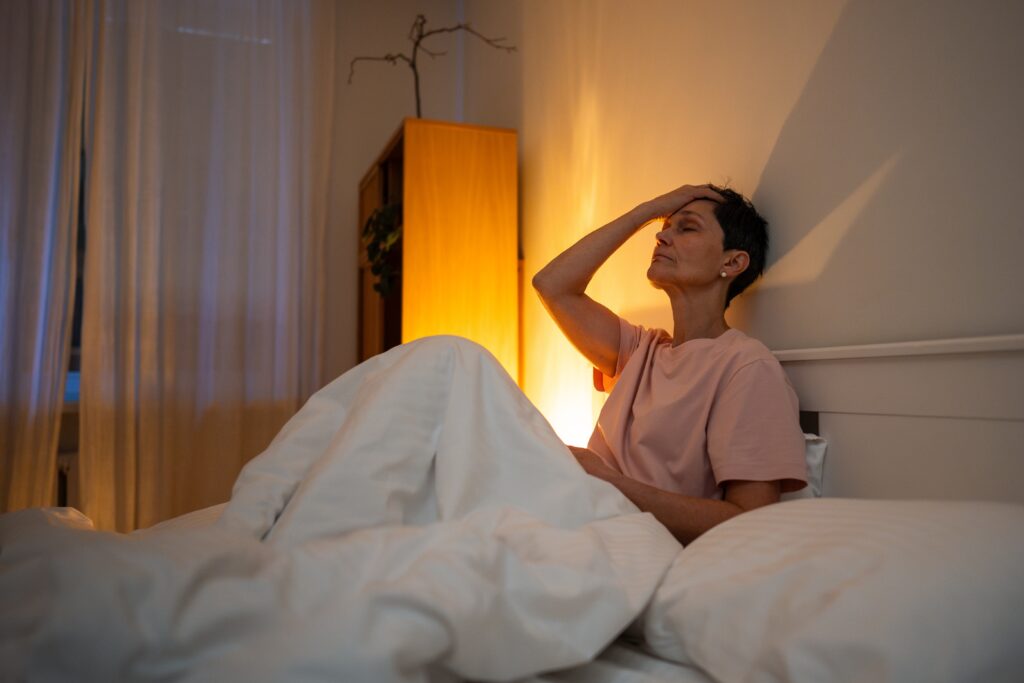
Perimenopause & Menopause: Cooling the Internal Heat
Around 40–60% of women experience sleep disturbances during perimenopause and postmenopause (4). And those fluctuating hormones can create haywire in our brain’s temperature control hub – leading to hot flushes and night sweats. This together with anxiety, irritation, stress and a higher risk of sleep apnea and restless legs syndrome, all mean that our sleep is negatively impacted during peri menopause and menopause.
Cooling Breath
A few rounds of Sitali Pranayama (cooling breath) can help to cool the blood and calm the mind. Curl the sides of the tongue and take a breath in – as if sipping the air through a straw. Then slowly exhale through the nose. Continue for 5-10 rounds.
Qigong and yoga
Ease yourself back to hormonal balance which some gentle Qigong sequences. And yoga poses such as Reclined Bound Angle and Wide-Knee Child’s Pose, can be a natural relief for menopause insomnia.
Wise Woman — Gentle Practices for Restorative Sleep in Later Life
As we move into our twilight years, our sleep habits shift and we can find ourselves waking more frequently and spending more time in lighter sleep. Interestingly, as teens tend to sleep and wake later, once we head into our 60s and beyond, we tend to sleep and wake earlier.
Sleep and deep rest is vital at this age to help protect heart health, maintain cognitive function and keep our immune system strong.
Keep moving, but you may feel more comfortable switching to a chair-based yoga class. At Thrive Journey, our experienced Yoga teacher, Beryl Broadbent teaches a weekly Seniors Chair-based Yoga class.
Extended Exhale
Take a breath in through the nose for 3 counts and then exhale through the mouth for 6 counts, so that your exhale is twice as long as your inhale. Do this 5-10 times. This helps to settle the nervous system. You can do this during the day, before bed and during the night.
Practices such as Qigong and Tai Chi can also improve sleep quality and nighttime calm, and a warm oil self-massage (Abhyanga) and evening rituals can help promote deep rest.
Yoga Poses That Promote Deep Sleep
Yoga can be hugely beneficial in helping to switch off a busy mind and come into a relaxed state. Studies have shown that exercise-based interventions – including yoga, Tai Chi and gentle aerobic exercise – improve sleep quality in people with insomnia and are recommended as accessible non-pharmacological treatments. (5)
Generally restorative yoga poses (using props) and poses that include forward folds (such as Caterpillar in Yin Yoga) as well as gentle inversions, such as Legs-Up-the-Wall (Viparita Karani) are helpful to encourage deeper sleep.

Guided Meditation for Falling Asleep
Guided visualisations, mindfulness and meditations can be a great way to switch from a racing mind, to feeling calm and centered.
Mindfulness-based interventions have been shown to significantly improve insomnia symptoms and sleep quality in adults with chronic sleep difficulties. (6)
Body scan meditations help to increase body awareness and induce the relaxation response. A loving kindness meditation (Metta Meditation) helps to ease anxiety, while sleep stories and visualisations are all calming and can soothe you into a deep sleep.
Even 5-10 minutes of guided meditation for falling asleep can be effective, but there are longer relaxations or even using ambient noise can help distract you from thoughts and mask background sounds.
Breathwork for Insomnia Relief
Generally our inhale is energising and our exhale is relaxing, so by focusing on the exhale you can invite a sense of calm into your mind and body.
The practices described in this blog such as the extended exhale, 4-7-8 breath, Golden Ribbon Breath and Diaphragmatic Breath are all soothing pranayama techniques that encourage us into the parasympathetic nervous system, helping to promote good quality sleep. Check out these other breathing practices and pranayama techniques.
Ayurvedic Sleep Remedies for Women
Ayurveda has a range of Ayurvedic Sleep Remedies for Women to help you feel grounded and calm. Try Abhyanga (self-massage with warm oil) before bed, explore balancing evening routines for Pitta and Vata doshas.
And you may like to try herbs to help support sleep, such as ashwagandha, chamomile, warm milk with nutmeg.
Building Your Nighttime Relaxation Routine for Women
Unwinding from your day doesn’t need to take a long time, in our Tired but Wired online class (this is live on August 30 and after that will be available in our On Demand Library in the Thrive Journey website) guides you through the RESET for REST routine – which takes just 12 minutes to help you decompress and come into a relaxed state for sleep.
Summary for the Life Stages
Teens – ditch the device, gentle Yoga in your PJs and 4-7-8 breath
20s and career – calm a busy mind, Progressive Muscle Relaxation and Body Scan
Fertility – ease stress, lower cortisol and diaphragmatic breathing
Pregnancy – side-lying relaxation poses, restorative yoga and Golden Ribbon Breath
New mums – micro-practices, be real, not perfect and Cosmic Sigh Breath
Peri and menopause – calm the nervous system, cooling Sitali Breath and gentle Qigong sequences.
Wise Woman – stay mobile with Chair Yoga, Qigong, extended exhale and encourage evening rituals
Aim for consistency over duration. Just 5 minutes a night is 30 minutes a week – and this can be all you need to encourage deep, restful sleep.
Conclusion
We can all benefit from good sleep hygiene – going to bed and waking at the same time, avoiding eating four hours before bed, keeping your room device free and cool (ideally between 15-19C), as well as having a bedroom which is dark and quiet.
But the right sleep relaxation technique also depends on where you are in life – and the good news is, there’s something effective for every stage.
At Thrive Journey, we know just how important it is to have good quality sleep and regular deep rest. Check out our Tired but Wired class which features the RESET for REST Method by Katie Brown and includes a range of sleep relaxation techniques for women.
References:
1: How Does Insomnia Affect Women?
2: https://pubmed.ncbi.nlm.nih.gov/31862277/
3: The Cleveland Clinic
https://my.clevelandclinic.org/health/diseases/pregnancy-insomnia
4: The Sleep Health Foundation
https://www.sleephealthfoundation.org.au/sleep-topics/menopause-and-sleep
5: Effects of various exercise interventions in insomnia patients
Bu Z, Liu F, Shahjalal M, et al. BMJ Evidence-Based Medicine. doi:10.1136/ bmjebm-2024-113512
https://ebm.bmj.com/content/ebmed/early/2025/07/09/bmjebm-2024-113512.full.pdf
6: Mindfulness-Based Interventions for Insomnia: A Meta-Analysis of Randomized Controlled Trials.
Wang YY, Wang F, Zheng W, Zhang L, Ng CH, Ungvari GS, Xiang YT. Behav Sleep Med. 2020 Jan-Feb;18(1):1-9. doi: 10.1080/15402002.2018.1518228. Epub 2018 Oct 31. PMID: 30380915.