
Trying to conceive brings hope, frustration and stress that can be difficult to explain unless experienced firsthand. Emotional ups and downs are normal and can be exhausting, but you are not alone. Reaching out for support from a friend, counsellor or support group can make a real difference. Many women turn to yoga and mindfulness alongside cycle tracking, nutrition and medical care to support emotional wellbeing, relaxation, sleep and coping with uncertainty. However, these practices are not proven cures for infertility.
That distinction matters. Mindfulness interventions significantly reduced anxiety, depression and perceived stress in women with infertility (1). Those are meaningful benefits, especially during a fertility journey that can feel emotionally consuming, even though they do not prove that mindfulness directly causes pregnancy rates to rise.
How can fertility yoga and mindfulness help you conceive naturally?
What yoga seems to do well
Fertility yoga is not one magic sequence or a set of poses guaranteed to improve reproductive function. In practice, it usually refers to gentle, low-strain movement paired with breath awareness, relaxation and nervous system support. That can matter because fertility challenges often accompany stagnation within the belly, muscle tension, hormone imbalance, neurological signal disturbing the immune, digestive and reproductive systems, disrupted sleep, racing thoughts and a sense of being disconnected from your body.
A systematic review of yoga for infertile individuals found the clearest benefits in stress, anxiety and depression, describing yoga as a useful adjunct during fertility treatment (2). Our wide range of expert-led programs makes it easier to access supportive practices at home, providing online yoga and mindfulness resources tailored for emotional wellbeing and coping throughout the fertility journey.
Why mindfulness is often central
Mindfulness can be especially useful because it asks less of the body on hard days. If movement feels tiring, a short practice of guided breathing, body scanning or nonjudgmental awareness may still help reduce overwhelm. This can lead to consistent improvements in perceived stress and mood, which helps explain why mindfulness is often recommended as part of supportive fertility care rather than a replacement for medical evaluation.
Some research on IVF and ICSI adds an important nuance (3). Anxiety and depression were associated with lower chances of successful pregnancy after treatment, while stress was not consistently linked in the same way. That suggests emotional distress matters, and that supporting your emotional wellbeing is essential.
What a supportive practice can look like
Creating a calming, repeatable routine that encourages gentle movement, mobility, body awareness, circulation, and relaxation without pushing intensity is the most practical. Adapt your routine to your comfort each day, allowing for more movement on some days and gentle stretching or rest on others.
What is Fertility Yoga?
Thrive’s Senior teacher Sarah Manning answers:
-
- A practice that is designed to lower stress hormones – adrenalin and cortisol – cooling and calming – switching to the parasympathetic nervous state often called the “rest and digest” state.
-
- A strong massaging effects to the belly – when a woman is seated all day – (from teenage years to when they are trying to conceive – we are talking years here!) there has been poor circulation to ovaries and womb – of blood and lymph – resulting in stagnation and the buildup of material like fibroids and endometriosis
-
- A practice designed to lengthen the exhalation, to bring movement to the diaphragm and deepen the release of held emotional belly tension
-
- Trauma release through opening to chest and hips
-
- The balance of yin and yang in your life – of doing and being. Bring harmony to your body and mind, by increasing the yin, inward, quiet, creative energy into the moment.
-
- The action of listening to your body and mind – tap into your intuitive wisdom
-
- Beginning to rebuilding the trust of your body – its intelligence, physiology and natural rhythms
These practices may support your overall wellbeing by reducing distress, supporting sleep, making self-care sustainable and supporting your hormonal balance. On tough days, set small, manageable goals such as five minutes of stretching or mindful breathing. Simple routines, supportive reminders or a practice buddy can help you stay consistent. Progress, not perfection, matters most.
These practices may support your overall wellbeing by reducing distress, supporting sleep, making self-care sustainable and supporting your hormonal balance. On tough days, set small, manageable goals such as five minutes of stretching or mindful breathing. Simple routines, supportive reminders or a practice buddy can help you stay consistent. Progress, not perfection, matters most.
How mindfulness may support conception indirectly
Mindfulness is often most valuable because it improves how you move through the process. Better coping can help you stay engaged with appointments, rest more consistently, and recover emotionally after disappointing news. A broader review of mind-body programs in infertility found benefits for psychological health and suggested there may also be some improvement in pregnancy-related outcomes. However, the evidence remains mixed and should be interpreted carefully (4).
This means mindfulness and other mind-body practices can be viewed as supportive tools alongside appropriate fertility care, rather than treatments that can be relied on to achieve conception.
If you are trying to conceive naturally and want to consider the bigger picture, it can help to explore other fertility pathways early. Experts generally recommend consulting a healthcare provider if you have been trying for 12 months (or 6 months if you are aged 35 or older) without success. This allows for earlier evaluation and support, so yoga and mindfulness stay in their proper role as support tools, not the only plan.
Safety matters, especially when pregnancy is possible
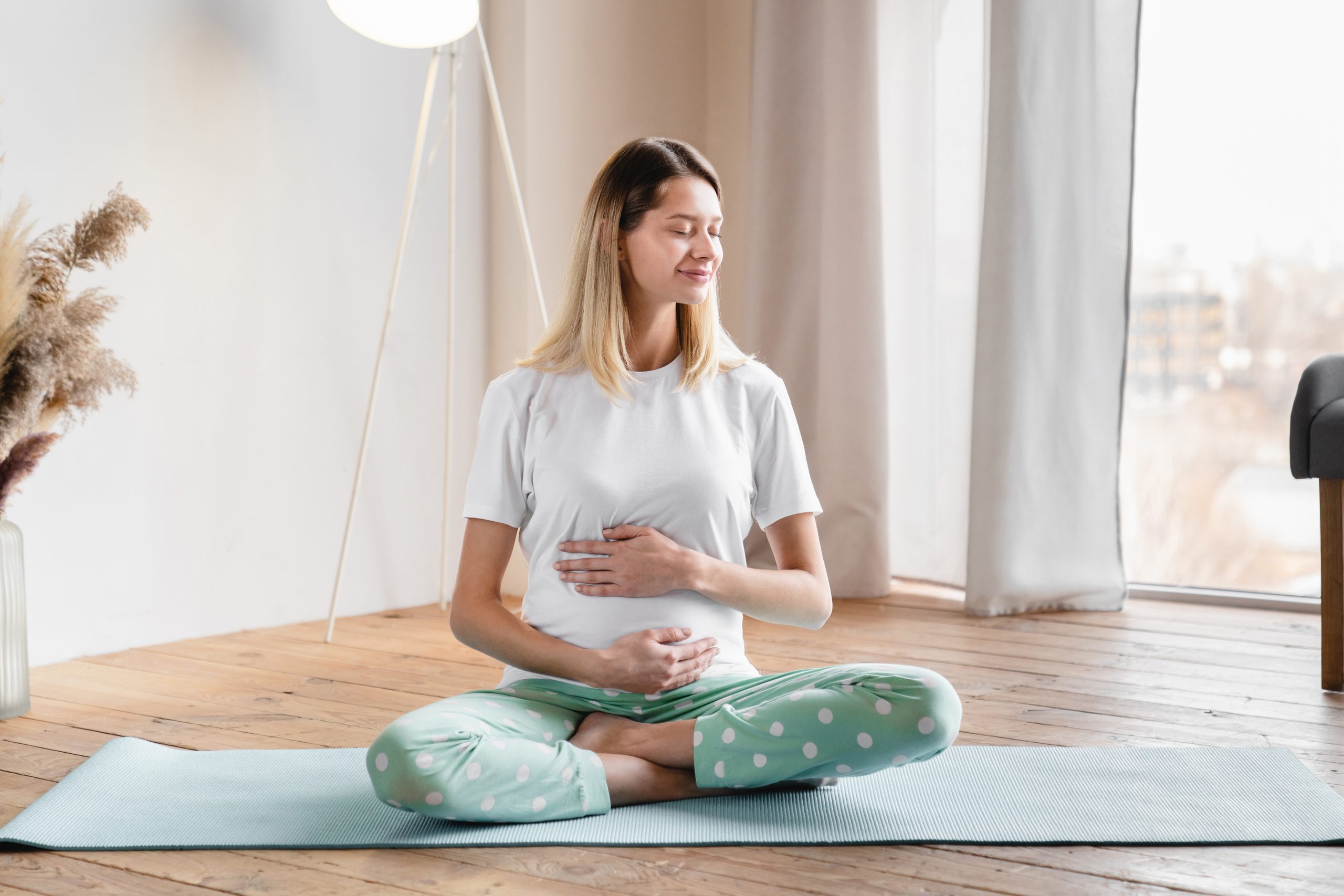
If you could already be pregnant or are actively trying, choose yoga that is gentle, well-instructed and easy to modify. Avoid treating this phase like athletic training. The goal is steadiness, not strain.
What is Safe yoga for the first trimester?
Thrive’s Senior teacher Sarah Manning answers:
Once you are confirmed pregnant, most yoga teachers will ask you to wait until your week 12 checkup before attending yoga, even prenatal yoga – this is to protect themselves from accusations of causing a miscarriage, since most natural miscarriages do occur then. At Thrive we recommend only practicing restorative yoga – why?
-
- Restorative yoga is about encouraging the deepest letting go and release, while supported by the floor, cushions and bolsters – there is no stretch, no pressure, just a held support. It’s about building the tools of deep relaxation and allowing.
-
- Allow best embedding of the fetus – through deep rest
-
- As the fetus grows the standard cells start by multiplying – and later start defining what each cell function is. What is a liver cell? what is a nose cell?… This requires a huge amount of energy – which could be why you feel so tired. It is time to rest and allow this work. After trimester 1 the cells have been defined and just grow and multiply.
The American College of Obstetricians and Gynaecologists advises avoiding hot yoga and hot pilates during pregnancy because of the risks. It also notes that long periods of lying flat on the back can become less comfortable and less appropriate as pregnancy progresses and that prenatal yoga classes are specifically designed with pregnancy-related changes in mind (5). Adapting your routine to how you feel is self-compassion, not a setback. Flexibility and kindness as your needs change are valuable parts of your journey.
Prenatal yoga safety at a glance
What is generally encouraged and what usually needs modification
| Generally supportive options | Usually avoided or modified |
| Gentle standing poses with support | Hot yoga or hot Pilates |
| Seated hip-openers | Long periods flat on the back later in pregnancy |
| Modified cat-cow | Balance-heavy poses without support later in pregnancy |
| Side-lying rest | Any pose that causes pain, strain or breath-holding |
| Open twists and gentle stretches | Deep, closed or uncomfortable twists that cause strain or discomfort |
| Simple breathing exercises | Held breath retentions and energising practices |
During pregnancy, levels of relaxin increase. This hormone helps prepare the body for birth by increasing flexibility in the ligaments and joints. However, this can also make it easier to overstretch without realising it, potentially placing extra strain on the joints, ligaments and surrounding tissues.
When practising yoga during pregnancy, avoid pushing into your maximum range of movement. Aim for around 80% of your usual stretch, keeping the sensation comfortable and controlled rather than trying to go deeper.
Pregnancy yoga is about supporting and creating space in the body – not increasing flexibility.
If you are unsure when to switch styles, the safest answer is often early. As soon as pregnancy is possible, it makes sense to favour classes and routines that are easier to adapt.

Breathwork and meditation tools that feel doable
If you feel too tired, emotional or physically uncomfortable for movement, start with breath. Try a comfortable breathing pattern with a slightly longer exhale, such as inhaling for four counts and exhaling for six, for a few minutes. A slightly longer exhale can help settle the nervous system and soften the sense of urgency that often comes with trying to conceive.
A bedtime meditation can also help if fertility stress is affecting sleep. Viewing wellness through connected habits, not just one practice, is often more effective, which is why a whole-person wellness approach can provide useful context.
Keeping expectations grounded and supportive
Fertility yoga and mindfulness are best understood as supportive practices, not guaranteed solutions. They help reduce anxiety, improve mood, support sleep and make the conception journey feel more manageable.
These practices are designed to support the healthiest version of yourself – physically, emotionally and mentally.
For women seeking gentle, real-life support including, fertility-focused yoga, breathwork, guided relaxation and yoga nidra. We also offer dedicated resources for those trying to conceive naturally or navigating fertility treatments like IVF and frozen embryo transfer. Our gentle online tools are designed to support your physical, emotional and mental wellbeing alongside your fertility care. Explore their resources at thrivejourney.com for guidance and community on your conception journey.
References
(1) Wen Y, Li X, Shu W, Zhang H, Shen Z, Huang Z. The effects of mindfulness therapy on infertile female patients: A meta-analysis. Technol Health Care. 2024;32(6):4983-4997. doi: 10.3233/THC-240174. PMID: 38943413; PMCID: PMC11612955. https://pmc.ncbi.nlm.nih.gov/articles/PMC11612955/
(2) Demir Yıldırım A, Güngör Satılmış İ. The Effects of Yoga on Pregnancy, Stress, and Anxiety in Infertile Individuals: A Systematic Review. Holist Nurs Pract. 2022 Sep-Oct 01;36(5):275-283. doi: 10.1097/HNP.0000000000000543. PMID: 35981112. https://pubmed.ncbi.nlm.nih.gov/35981112/
(3) Lu Q, Cheng Y, Zhou Z, Fan J, Chen J, Yan C, Zeng X, Yang J, Wang X. Effects of emotions on IVF/ICSI outcomes in infertile women: a systematic review and meta-analysis. J Assist Reprod Genet. 2025 Apr;42(4):1083-1099. doi: 10.1007/s10815-025-03388-7. Epub 2025 Jan 28. PMID: 39875719; PMCID: PMC12055742. https://pmc.ncbi.nlm.nih.gov/articles/PMC12055742/
(4) Ha JY, Ban SH. Effects of Mind-Body Programs on Infertile Women: A Systematic Review and Meta-analysis of Randomized Controlled Trials. Asian Nurs Res (Korean Soc Nurs Sci). 2021 May;15(2):77-88. doi: 10.1016/j.anr.2021.02.003. Epub 2021 Feb 16. PMID: 33607300. https://pubmed.ncbi.nlm.nih.gov/33607300/
(5) American College of Obstetricians and Gynecologists (ACOG). Exercise During Pregnancy. https://www.acog.org/womens-health/faqs/exercise-during-pregnancy