Check out our Thrive Journey guide to create moments of calm within your busy day – at any life stage or age.
Deadlines, demands and jobs – life can feel like a never ending to-do list. But one way to press pause and enjoy a moment of calm is to commit to a practice of meditation and yoga for daily life.
This could be a ten minute routine, a breathing practice or a calm daily meditation. Once you bring these practices into your day, they become a go-to habit, which can help you at whatever life stage you are in.
For teens, it could be a moment of mindfulness to reset raised emotions, or perhaps a cooling pranayama when experiencing a hot flash in menopause, or simply switching from a state of overwhelm to one of gratitude in retirement.
Weaving these practices into your life doesn’t have to be yet another job on your to do list, it can be a small intentional moment to keep you feeling grounded, calm and content.

Finding Your Ground in a Fast-Moving World
As women we don’t just have one job – we have multiple tasks everyday: Cook, chauffeur, bookkeeper, cleaner, secretary – the list goes on! As wives, mothers, grandmothers, daughters, carers – it isn’t surprising that often our own health is at the bottom of the list.
An Australian study (1) found that women spend an average of 4 hours and 31 minutes doing unpaid work activities such as housework, shopping, preparing food and volunteering etc… every single day. Compared to men who spend more than an hour less on these activities, (3 hours and 12 minutes, on average).
But with demands and deadlines, there is an emotional toll and a huge mental load. If we don’t take time out for practices such as yoga and meditation, we risk feeling disconnected from our mind, body and breath.
Yoga and meditation act as ‘anchors’ which bring us back to ourselves, home to our body and our breath. If we are in a constant state of stress, our breath becomes shallow, our muscles tense, our digestion and other key body functions, such as immunity, reproduction and respiration all suffer and we can easily become depleted and exhausted.
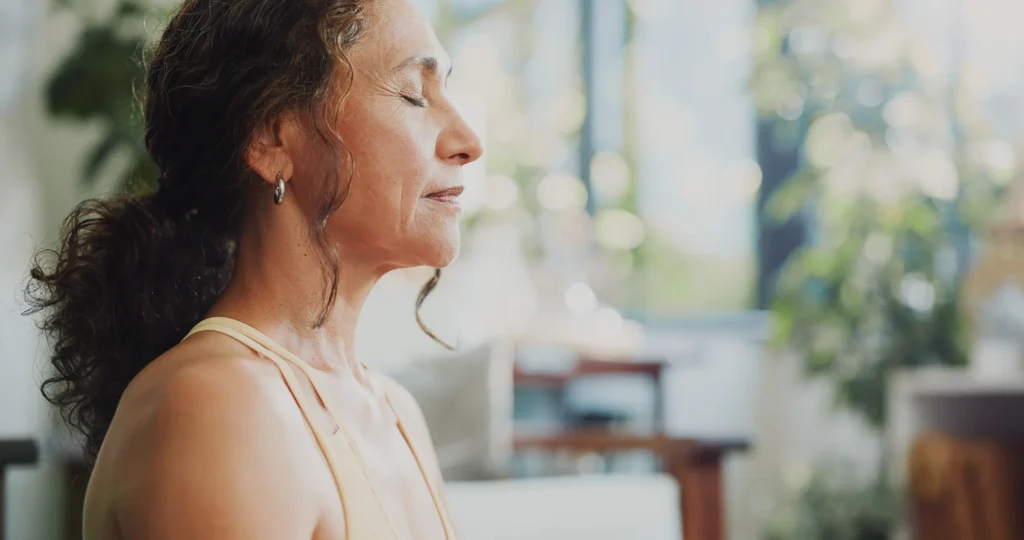
Meditation and Yoga for Daily Life: Why It Matters at Every Stage
Daily guided meditation and yoga are generally regarded as helpful ways to help reduce stress and improve physical and mental health for all women – in all life stages.
A research paper published in 2025, (2) found mental health disorders – including depression and anxiety – are significantly more prevalent in women due to hormonal fluctuations, caregiving responsibilities and sociocultural stressors.
The study also identified meditation as a promising tool for addressing the unique mental health needs of women. It stated; meditation offers physiological and psychological benefits that span across various life stages.
Daily meditation and yoga help with emotional health and regulation – keeping you grounded and encouraging a clear perspective on situations. It can also improve focus, cognitive function and improve energy levels and social interactions.
Yoga and meditation are also proven to help aid better sleep and focus as well as resetting the nervous system.
Another study: Effects of Yoga on Heart Rate Variability and Depressive Symptoms in Women (3) found that a 12-week yoga program was effective in increasing parasympathetic tone (helping the body into a more relaxed state) and reducing depressive symptoms and perceived stress in women with elevated depressive symptoms.
The study revealed yoga can improve HRV (Heart Rate Variability) – which is the timing between heart beats and an indicator for heart health, stress resilience and recovery.
How Stress Shows Up Differently Across Life Stages
The underlying stress response is similar for all of us, but how it impacts us can be quite different according to our age and stage of life.
Teenagers and young adults can be faced with uncertainty on identity, exam and social pressures as well as study and career choices. As we get older we tend to have increased responsibilities which can include financial stresses, caring for others and the possibility of burnout.
Fertility, pregnancy and early motherhood each have their own challenges which can be difficult to navigate. And as we journey through life, we need to adapt and cope with emotional upheavals such as job insecurity, relationships issues and parenting, as well as dealing with physical health issues, hormonal imbalance and the highs and lows life can throw at us.
Understanding Stress and the Need for Daily Grounding
Stress shows up for us in a huge variety of ways – when stressed we tend to have shallow breathing, which exacerbates the stress response, our body switches to the sympathetic nervous system where blood flow is directed from our internal organs to our extremities. Over time this can lead to digestive, circulation and respiratory issues. We could experience a range of symptoms from breathlessness to a racing heart, bloating and muscle tension. Energetically, this quickly leads to fatigue as our body attempts to function within this stressed state and we quickly become depleted.
Emotionally we are on edge, often quick to anger, irritation and find it hard to focus and remain calm.
There are so many benefits of meditation and yoga; both help us to feel centered and grounded – Instead of feeling overwhelmed and underappreciated. The Relaxation Response (a term coined by Cardiologist, Dr Herbert Benson) is initiated as we begin to slow and deepen our breath, quieten our mind and ease into a parasympathetic state (known as the healing state). The more we practice the easier it becomes to shift into this state, which means we will feel more energised, calmer, with a clearer focus. Read more on yoga for stress management and anxiety relief here.
Yoga for Stress Management Through Gentle, Consistent Practice
The good news is that short, regular practice is more effective than the occasional longer session. So you don’t need to set your alarm for 4am, meditate for an hour and do 108 Sun Salutes!
There are simple breathing techniques, meditation practices and yoga for stress relief routines that you can weave into your day which will help bring you back to your centre.
Getting Started: Yoga and Meditation for Beginners
Author, Wendell Berry stated thatThinking is overrated!Solet go of expectations, don’t put it off – just start with these two yoga and meditation practices for beginners:
#1: Breath Awareness
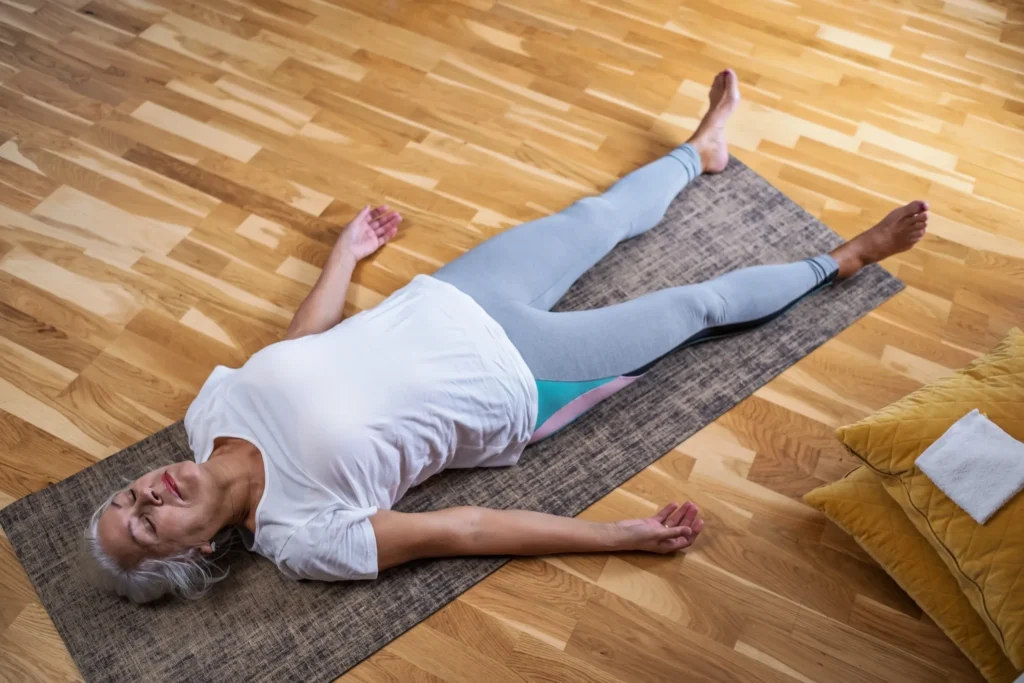
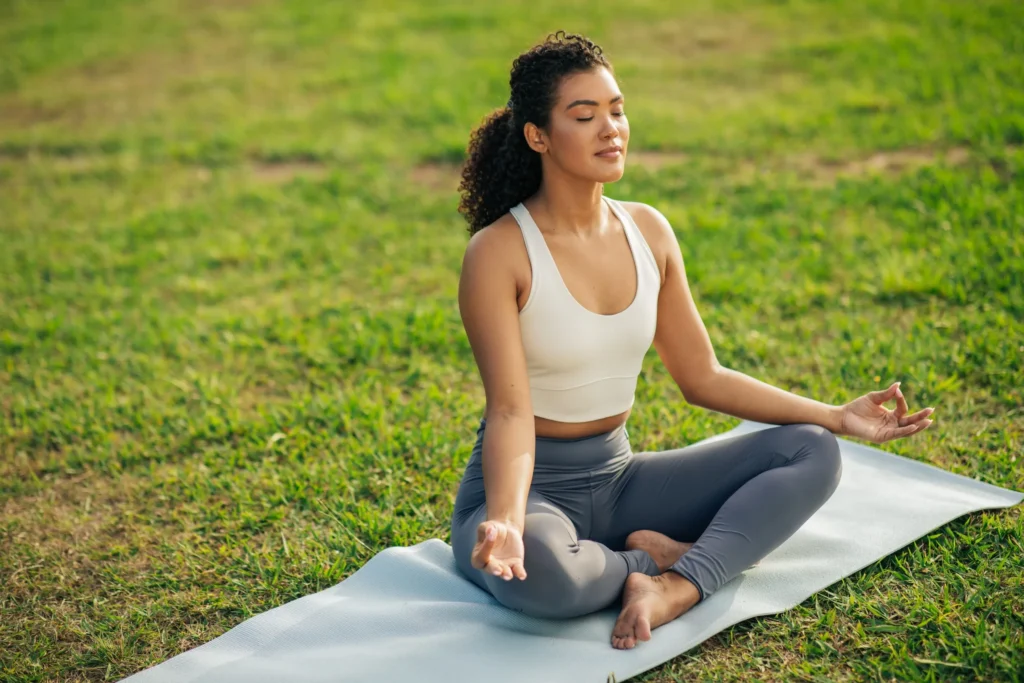
Come into an easy sitting position, with your spine long. You may like to sit on a rolled up blanket or low cushion against a wall. Relax your shoulders and find a comfortable position.
If sitting is difficult, you can always lie in a supported Savasana on the ground.
Lie flat with a small cushion or folded blanket under your head and a pillow under your knees. Let your arms rest on the ground about 20 cm away from your hips, with your palms up and your feet turned out.
Begin to notice your breath. Not changing or controlling the rhythm of your breath, simply being curious – observing as the breath moves in and out of your body.
Pay attention to the temperature of the inhale and exhale, the movement of the breath and the movement of the body as it accommodates each breath.
When thoughts enter your mind (as they will) just notice, then let them dissolve – be aware of the space behind the thoughts and tune into sensations within the body as you focus on your breath.
Do this for 5-10 minutes during your day. You can even do this while sitting in the bus or waiting in line at a shop.
#2: Standing Cat – this yoga movement is great for days when you are stuck at your desk.
#1: From standing, rest your hands above your knees, with your fingers pointing towards each other.
#2: Inhale, and begin to lift your tailbone – moving vertebrae-by-vertebrae. Draw your shoulder blades towards one another as you feel a gentle arch in the spine. Combine the movement with your breath, so that by the end of the inhale your gaze is forward and slightly raised.
#3: On your exhale, reverse the movement, so you begin with the tailbone again – rounding the tailbone under, moving vertebrae-by-vertebrae until your chin rests towards your check and your spine is arched, like an angry cat.
Repeat 5-10 times, every 1-2 hours.
Letting Go of Perfection and Building Awareness
Your practice does not have to be perfect. And you need to resist excuses, such as : “I don’t have time,” or “I’m not flexible.”
As the famous yogi, T.K.V. Desikachar is credited with saying:
“You don’t fit the yoga, the yoga fits you.” So remember, let the practice work for you.
Create a routine which you know you can manage.
This could mean lying down instead of being seated or perhaps doing a walking meditation – where you go into nature and take your awareness to your senses: what you can hear, see, smell, feel and taste.
Building a Daily Meditation Practice That Supports You
It’s a good idea to have a regular time for your practice. This could be waking up a few minutes early and doing a morning meditation or spending a few minutes before bed, winding down from your day.
You may find it helps to set an alarm on your phone or write notes – behind the bathroom door can be a good place, just to remind yourself to exhale and shift from your mind to your body.
Keep it short and consistent – and congratulate yourself for sticking to your practice.

Simple Yoga Practices to Support Your Daily Life
Bring in micro practices throughout your day – such as stretch breaks, mindfulness moments and breathing practices between meetings. Focus on flexibility – not rigid schedules.
Morning: Ease yourself into the day with slow movement. Aim to release your joints with hip circles, wrist. Shoulder and ankle circles. Move your spine in all directions – a side stretch, easy twist, gentle back arch and a forward fold.
Day: during the day, take regular breaks from your desk and device. Walk, take a moment in nature (even if it is opening the window and looking at the clouds) and move your body (try Standing Cat explained earlier in this article).
Evening: This is the time to incorporate wind-down stretches from your day. Restorative yoga and yoga nidras are great for the evening. You night like to journal before bed, so you can clear your mind before having a long, uninterrupted sleep!
Bringing It All Together: Creating Your Own Daily Practice
So how to meditate daily? The key thing is to know there is no right or wrong way. Meditation can seem as if it is shrouded in mystery, and it can be hard to know if you are doing it correctly. But Everyone is different and we all find the style and practice that suits us.
The aim is to still and quieten the mind. And even if you achieve this for a few seconds, then you have had a positive experience. The more you tune into the practice, the easier and more familiar it will become and you will start to notice the benefits ripple through your mind, body and life.
The same is true for yoga. Begin with a short daily routine – build from there and make it enjoyable and achievable. And if you miss a day’s practice, don’t give up. Stick with it. Try out different styles, and when you have a busy life you’ll often find it is beneficial to have a slower more nourishing practice. Restorative and Yin Yoga can be a great yoga style for working women.
Appreciate that your routine will change throughout your life and being flexible and adaptable is part of your practice.
- At Thrive Journey, we offer a wide variety of ways you can create a yoga for daily life practice. This could be with our weekly live, online 30 minute Qigong, meditation and yoga sessions and exploring our 300 plus on-demand videos and courses to help you discover techniques you can implement during your day to help you feel calm and grounded.
References:
- How Australians Use their time: Australian Bureau of Statistics (2020-21), How Australians Use Their Time, ABS Website
- International Journal of Sports, Health and Physical Education – Meditation as a Holistic approach to women’s mental health (2025): https://www.researchgate.net/profile/Km-Megha-2/publication/390061499_Meditation_as_a_holistic_approach_to_women’s_mental_health_A_narrative_review/links/68788f16b3294610e9b82c3c/Meditation-as-a-holistic-approach-to-womens-mental-health-A-narrative-review.pdf
- Effects of Yoga on Heart Rate Variability and Depressive Symptoms in Women, published in the Journal of Integrative and Complementary Medicine Chu, I.-H., Wu, W.-L., Lin, I.-M., Chang, Y.-K., Lin, Y.-J., & Yang, P.-C. (2017). Effects of Yoga on Heart Rate Variability and Depressive Symptoms in Women: A Randomized Controlled Trial. Journal of Alternative and Complementary Medicine (New York, N.Y.), 23(4), 310–316. https://doi.org/10.1089/acm.2016.0135